From Idea to Live Show: The Story Behind Big Deal Show
 15.06.2026 | 4 min
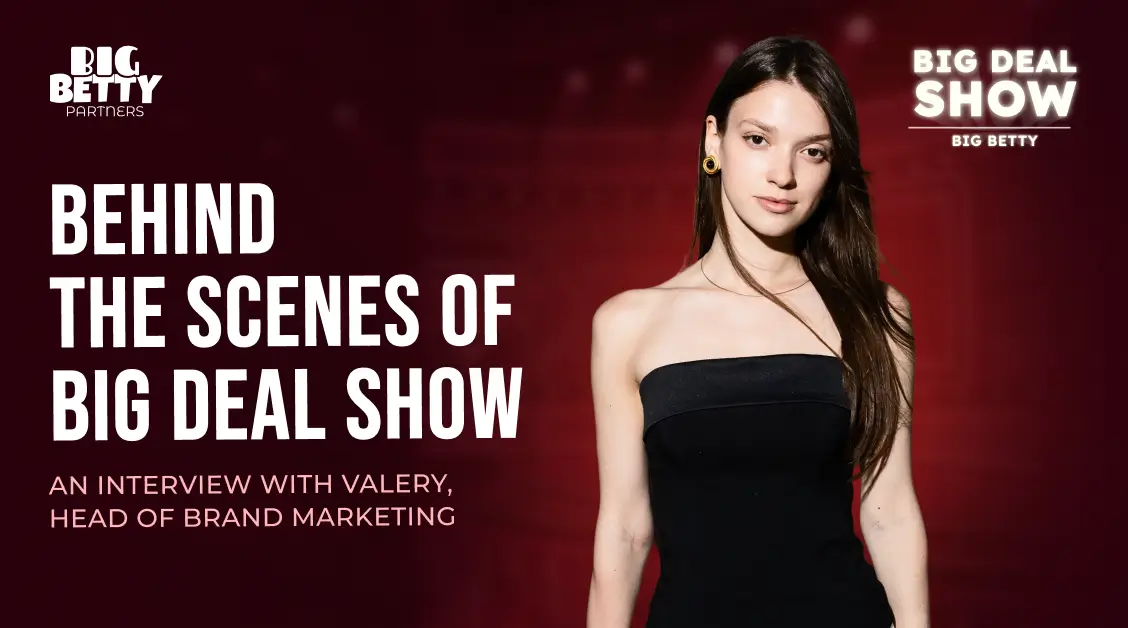
At a time when most affiliate programs compete through bonuses, commission increases, and traditional promotional campaigns, Big Betty Partners decided to take a different path. The result was Big Deal Show — a large-scale project that kept partners engaged for three months and culminated in a full-scale live broadcast on June 5, 2026.
Behind the bright visuals, studio lights, and final live show stood months of preparation, dozens of specialists, and hundreds of decisions made along the way. To uncover the story behind the project, we spoke with Valery, Head of Brand Marketing at Big Betty Partners, about how the idea for Big Deal Show was born, what happened behind the scenes, the challenges the team faced, and the results the campaign ultimately delivered for both the brand and its affiliates.
Join us behind the scenes of Big Deal Show through Valery's perspective — from the first brainstorming sessions and strategic decisions to the live finale that became the culmination of the entire campaign.
Differentiation as a Strategy: How Big Deal Show Began
How was the idea for Big Deal Show born?
The Big Betty team has always aimed to surprise both partners and the market with unconventional ideas. For us, it has never been enough to simply be present in the industry — we want to create experiences people genuinely remember.
Looking back, we've been experimenting with new audience engagement formats for several years. International conferences became our first testing ground. It was there that we began exploring unconventional ways to attract attention, engage visitors, and validate our own marketing hypotheses.
One of our earliest initiatives involved promotional activations featuring stilt performers. While it looked like a simple entertainment element from the outside, the reality was far more complex. We had to account for safety requirements, logistics, and the challenges of operating in venues crowded with thousands of attendees.
As we gained confidence, we moved on to more sophisticated interactive concepts. One of the most successful was the Gold Bar Challenge, where participants had only a few seconds to pull a gold bar from a transparent cube. Another crowd favorite was a live slot-machine activation featuring actors specially invited from a well-known television series. These experiences did more than attract attention — they helped us better understand audience behavior and measure reactions to different engagement formats.
Each activation became part of a larger learning process. We tested hypotheses, analyzed engagement metrics, collected feedback, and gradually developed a deeper understanding of what modern affiliates actually expect from a partnership program. It became clear that bonuses and traditional promotions were no longer enough. Partners wanted emotion, interaction, and a genuine connection with the brand.
That realization ultimately led to the idea of Big Deal Show. We understood that individual activations, no matter how successful, could no longer fully support our ambitions. We wanted to create something larger — a project capable of combining marketing, entertainment, partner engagement, and brand storytelling within a single experience.
That was the moment when work on Big Deal Show truly began.
Tell us more about the concept behind the project and what made it different from anything else on the market.
Before starting the project, we spent a significant amount of time analyzing the market, studying competitors, and exploring different entertainment concepts that could serve as inspiration. During that research process, we came across the iconic television shopping shows and infomercials that became cultural phenomena in the 1960s. Back then, people gathered around their television sets, eagerly waiting for new offers, following charismatic hosts, and becoming part of the experience itself.
That was the moment we realized this atmosphere could become the perfect foundation for Big Deal Show.
We took a format familiar to millions of people, reimagined it through the lens of affiliate marketing and iGaming, and added the elements our audience enjoys most: anticipation, rewards, live interaction, humor, and a touch of sarcasm.
What made the concept even more natural for us was its connection to the Big Betty brand itself. Betty's character and visual identity are heavily inspired by the aesthetics of that era, so the show never felt forced or artificial. On the contrary, it became a natural extension of the brand and allowed us to bring its personality to life on a much larger scale.
Looking back, I believe we successfully executed the vision we had from day one. But ultimately, the best validation comes from the audience itself. The reaction from partners and viewers confirmed that the concept resonated exactly as we hoped it would.
For anyone who hasn't seen it yet, the full version of Big Deal Show is now available on Big Betty Partners' official YouTube channel.
From Idea to Show
Valery, tell us what was happening behind the scenes and what challenges the team faced?
We were essentially building a standalone media product. We had to organize promo shoots, find a strong production team, write scripts, develop the design of all show elements, cast actors, create character looks, and think through dozens of details that viewers often don't even notice — but which shape the overall perception of the project.
A separate challenge was the live broadcast itself. Unlike pre-recorded content, live shows leave no room for error. Everything matters: the technical crew, the script, timing, interaction between participants, and the speed of decision-making during the stream.
In parallel with show production, we were working on the marketing layer. Our goal was not only to engage existing Big Betty Partners partners, but also to attract a new audience. For this, we developed a dedicated communication strategy and media plan that allowed us to reach partners across multiple channels and maximize awareness ahead of the broadcast.
One of the most difficult decisions was related to the prize pool. We deliberately chose a strategy of suspense and decided not to reveal the main prizes until the very end of the campaign. From a marketing perspective, this was a risky move. Typically, participants want to immediately understand what they are competing for and what reward they can expect. But we leaned into the emotion of anticipation and gradually built interest in the project.
Another interesting challenge was aligning the show's visual style with the expectations of a modern audience. Since the Big Deal Show was inspired by 1960s aesthetics, all prizes featured during the broadcast matched that concept. On stage, viewers could see retro telephones, vintage household appliances, and other items from that era.
However, we fully understood that partners ultimately want modern technology, not museum pieces. That's why the team developed a prize upgrade mechanic. After purchasing a retro item using the show's internal currency — Betty Points — participants could choose a modern equivalent from several options. For example, a retro phone could be upgraded to an Apple Watch or ROG Ally X, an old hairdryer could become a Dyson, and other items received similarly relevant tech upgrades.
In essence, we transferred gamification into the reward system itself. Partners didn't just receive a prize — they could actively choose its final form. This freedom of choice became one of the most pleasant surprises for participants and received very positive feedback from the partner community.
Results and Expectations: Did Big Deal Show Achieve Its Goals?
What expectations did the team have for the project?
The first was the product itself. From the very beginning, we understood that Big Betty could not afford to launch just another standard promotional campaign.As a top-tier affiliate program, we always strive to set new standards and introduce fresh ways for the industry to engage with brands. That is why it was critical for us to make Big Deal Show a complete and cohesive product, where every element supported the overall concept.
We paid special attention to the visual side of the campaign: the design, promotional videos, communication style, stage setup, character styling, and the show itself. Everything had to feel like one unified story rather than a collection of separate activities. Our first expectation was to create a project that reflected the level of the Big Betty brand and would stand out in the market.
The second category focused on business results. Before the launch, we defined a set of key performance indicators and monitored them throughout the entire campaign. We wanted to understand how many existing partners would join the project, how many inactive partners we could reactivate, how many new partners we could attract through the campaign, and what results we would achieve in terms of FTDs, audience engagement, and show viewership.
We also closely analyzed participant interaction with the campaign mechanics, overall engagement around Big Deal Show, and audience interest throughout different stages of the project.
In my opinion, one of the biggest mistakes in creative projects is focusing solely on a great idea while forgetting about business objectives. Real success happens when a strong concept is backed by measurable results. That is why, for us, Big Deal Show was never just a show or a marketing campaign—it was a tool designed to achieve specific business goals.
It's very interesting to hear about the results. What did you achieve in numbers?
The first result was the product itself. Our goal was to create a project that looked professional, cohesive, and aligned with the standards of the Big Betty brand.I am confident that we achieved exactly that. The final outcome fully matched the vision we had from the very beginning—from the visual identity and production quality to the final Big Deal Show broadcast.
The second result was industry recognition. Big Deal Show was shortlisted for the SiGMA Europe Awards 2026, and for us this became an important confirmation that the industry values not only performance-driven campaigns but also genuinely creative ones. Of course, we believed in the project's potential, but being recognized among the industry's best works is always a significant indicator of quality and execution.
As for business performance, the results exceeded our expectations as well. Shortly after the campaign launched, we saw a noticeable increase in partner activity. Most participants became more active in driving traffic and generating FTDs, while nearly all active Big Betty partners joined the campaign.
Partner reactivation was another major achievement. We successfully reactivated around 57% of inactive partners from the target database we worked with throughout the project. In affiliate marketing, this is a very strong result, especially considering that these were partners who had shown little or no activity for a significant period of time.
Another important outcome was new partner acquisition. This area delivered some of the strongest results of the entire campaign. While I cannot disclose the exact numbers due to company policy, I can say that we achieved substantial growth and performance metrics that fully validated the strategy we chose.
For me, these results highlight several important conclusions. First, the Big Deal Show concept genuinely resonated with the partner audience. Second, the three-month campaign format allowed us to maintain engagement and interest throughout the entire lifecycle of the project. And third, our marketing and communication strategy was built correctly, enabling us to transform a creative idea into measurable business results.
What Results Did Affiliates Achieve?
On one hand, partners continued earning their standard commissions based on the agreed traffic terms. On the other hand, every FTD generated during the campaign was converted into Betty Points, which could be used during Big Deal Show to claim prizes and participate in various project mechanics. This created an additional layer of motivation and engagement within the affiliate program.
Another important outcome was the significant increase in interaction between the affiliate team and partners. Our goal was not simply to launch a promotion, but to create more touchpoints and opportunities for communication. Thanks to the campaign's carefully designed mechanics, we were able to substantially increase both partner engagement and the frequency of interactions with our team.
Introducing new partners to Big Betty Partners was another key objective. We wanted to showcase not only our partnership terms but also our overall approach to building long-term affiliate relationships. The campaign results confirmed that we successfully attracted the attention of new audiences and generated additional interest in the program.
Overall, we established specific goals and success metrics for each partner segment. That is why we can confidently say today that Big Deal Show achieved its objectives both for Big Betty and for our partners.
And if any readers happened to miss the campaign for whatever reason, I can assure you: this is only the beginning. Big Betty is already preparing new activities, unconventional projects, and exciting surprises for the affiliate community. Some of them will be revealed very soon at iGB L!VE London.
So, book a meeting with our team and join Big Betty Partners. The most exciting part is still ahead.
F.A.Q.
-
How was the idea for Big Deal Show born?
The Big Betty team has always aimed to surprise both partners and the market with unconventional ideas. International conferences became our first testing ground, followed by activations like the Gold Bar Challenge and live slot-machine experiences. Each activation became part of a larger learning process until the idea of Big Deal Show emerged as a single experience combining marketing, entertainment, partner engagement, and brand storytelling.
-
What made Big Deal Show different from anything else on the market?
Big Deal Show was designed to be fundamentally different from standard affiliate promos. The team reimagined 1960s television shopping shows through the lens of affiliate marketing and iGaming, adding anticipation, rewards, live interaction, humor, and sarcasm. The concept aligned naturally with Big Betty's retro-inspired brand identity.
-
What was happening behind the scenes and what challenges did the team face?
The team built a standalone media product with promo shoots, scripts, design, casting, and live-broadcast logistics. Marketing ran in parallel with production. Key challenges included keeping the prize pool secret until the finale and aligning retro show aesthetics with modern prize expectations through a Betty Points upgrade mechanic.
-
What expectations did the team have for the Big Deal Show project?
Expectations split into product quality and business performance. The team wanted a cohesive brand experience and tracked KPIs around partner participation, reactivation, new acquisition, FTDs, engagement, and show viewership throughout the three-month campaign.
-
What did Big Deal Show achieve in numbers?
Results included a polished final broadcast, a SiGMA Europe Awards 2026 shortlist nomination, increased partner activity, reactivation of around 57% of inactive partners in the target database, and strong new partner acquisition metrics that validated the campaign strategy.
-
What results did affiliates achieve through Big Deal Show?
Partners kept standard commissions while earning Betty Points on FTDs for show prizes and mechanics. The campaign increased affiliate-team touchpoints, attracted new partners, and confirmed that Big Deal Show delivered value for both Big Betty and its partner base. More activities are planned, including reveals at iGB L!VE London.
Related news
Top iGaming GEO in Practice: Tier Markets, Affiliate Fit & Partner Choice
Tier markets in iGaming: how GEO shapes affiliate performance, Tier 1 vs Tier 2 economics, European casino affiliate programs...
Best Traffic Sources for iGaming in 2026: Data, GEOs, and Conversion
The iGaming industry continues to draw ambitious partners. Best traffic sources for casino affiliate marketing in 2026...
Professional Criteria for Choosing a Casino Affiliate Program
Learn how to choose a casino affiliate program: traffic compatibility, GEO coverage, payout models, and support...