iGaming Affiliate Tracking Setup: The Tools and Methods That Actually Work
 22.06.2026 | 5 min

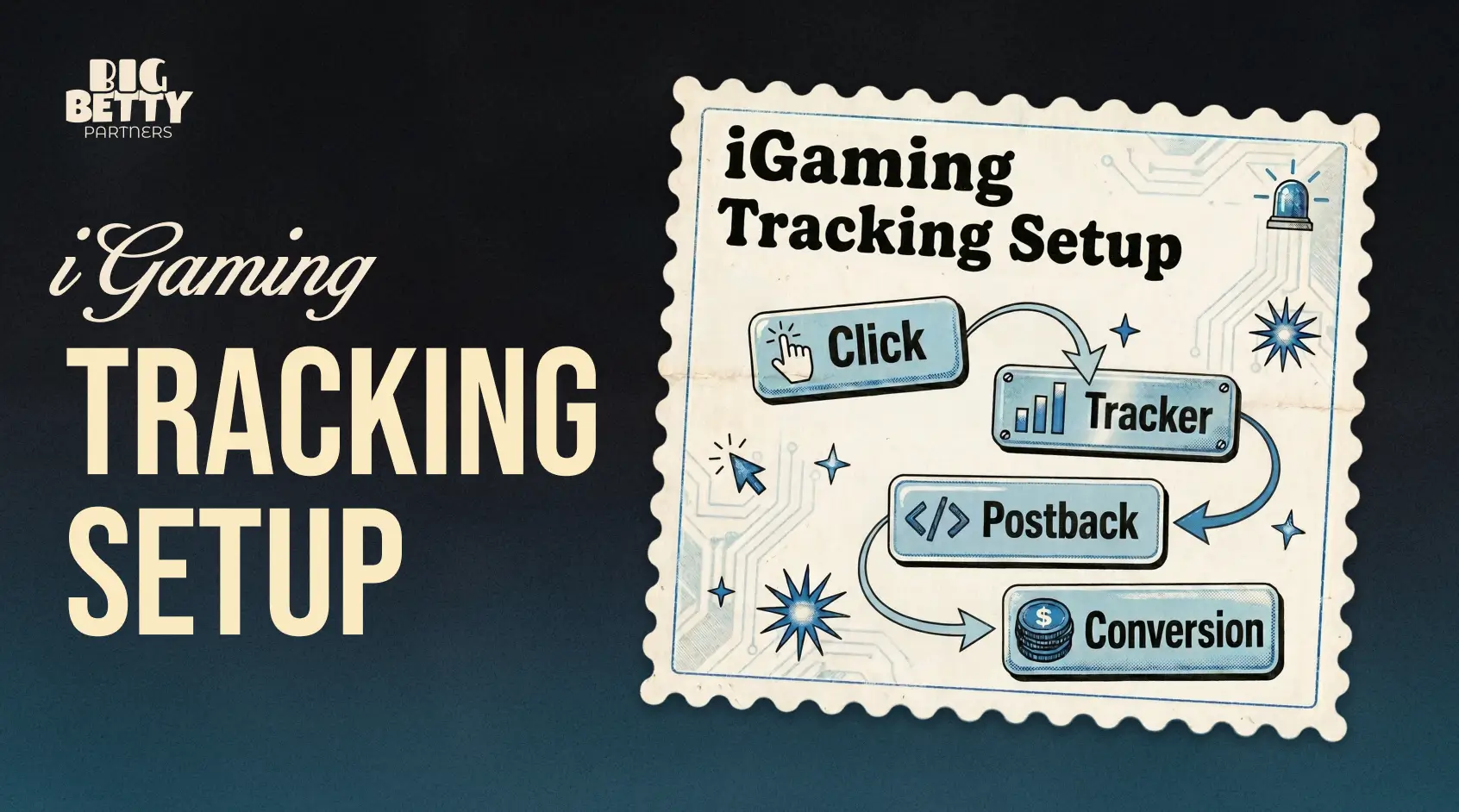
Affiliate tracking in the iGaming industry is not a set-and-forget configuration. It determines whether your commission reports accurately reflect the value of your traffic or leave gaps in attribution.
According to iRev's 2026 research, browser privacy restrictions have reduced the reliability of cookie-based tracking across 25–35% of global web traffic, while more than 40% of desktop users run ad blockers that can prevent conversion pixels from firing. WeCanTrack also reports that affiliate programs using server-side tracking record 18–24% more attributed conversions than those relying primarily on third-party cookies.
Building an effective tracking setup comes down to three elements: the tracking method, the tracking platform, and the attribution configuration.
💡 This guide covers one piece of the puzzle.
See the full picture: iGaming Affiliate Software & Tools: The Complete 2026 Stack

What Is iGaming Affiliate Tracking and Why Does It Differ From Standard Affiliate Software
Most affiliate tracking systems track a single conversion event, such as a lead or sale. In the iGaming industry, tracking must support a multi-event lifecycle that typically includes click, registration, FTD, QFTD, and NGR reporting.
FTD (First Time Deposit) is the primary commission trigger in many affiliate programs. QFTD (Qualified First Time Deposit) introduces an additional qualification threshold before commission becomes payable, helping ensure traffic quality.
NGR (Net Gaming Revenue) serves as the basis for Revenue Share calculations. Affiliate programs generate NGR data within their backend systems and use it to calculate affiliate commissions. Browser-side tracking methods cannot reliably capture this information, so affiliate programs send NGR data through API integrations or server-side postbacks.
It is also important to distinguish between affiliate-program platforms and affiliate-side trackers. Affiliate program platforms manage attribution, reporting, and commission calculations. Affiliate-side trackers help affiliates monitor traffic, campaign performance, costs, and conversion paths. According to WeCanTrack's 2026 affiliate tracking research, 94% of affiliate marketers use tracking tools to monitor clicks, conversions, and sales.
| Category | Affiliate Program Platform | Affiliate-Side Tracker |
|---|---|---|
| Purpose | Manage attribution and commission reporting | Manage traffic and campaign performance |
| Controlled By | Affiliate program | Affiliate |
| Events Tracked | Registration, FTD, QFTD, NGR | Clicks, traffic sources, costs, conversions |
| Examples | Affilka, ReferOn, Cellxpert, MAP, MyAffiliates | Keitaro, Voluum, BeMob, RedTrack |
| Main Objective | Conversion attribution and commission reporting | Campaign optimization and traffic analysis |
In practice, successful affiliates use both systems together. The affiliate program platform determines how conversions and commissions are attributed, while the affiliate-side tracker provides the traffic and campaign data needed to optimize performance and identify profitable traffic sources.
Tracking Methods Compared: S2S Postback, Pixel, and Cookie
The tracking method used by an affiliate program directly impacts attribution accuracy.
S2S (server-to-server) postback tracking sends conversion information directly from the affiliate program's backend to the affiliate's tracking platform. Because no browser interaction is required, S2S tracking is unaffected by ad blockers, Intelligent Tracking Prevention (ITP), or third-party cookie restrictions.
Pixel tracking relies on a browser loading a confirmation page after conversion. This creates several points of failure, including ad-blocking software, browser privacy mechanisms, and page abandonment before the pixel loads.
Cookie-based tracking continues to face increasing limitations. Browser developers continue to phase out third-party cookies, while privacy-focused browsers limit the lifespan of JavaScript-created first-party cookies. Server-set HTTP cookies remain more resilient but are still less reliable than backend-based attribution.
| Method | Accuracy | Mobile Performance | Ad Blocker Resistance | iGaming Suitability |
|---|---|---|---|---|
| S2S/Postback | Highest | Excellent | Fully Resistant | Excellent |
| API-Based | Highest | Excellent | Fully Resistant | Excellent |
| First-Party Cookies | Moderate | Reduced by ITP | Partial | Moderate |
| Pixel Tracking | Moderate | Limited | Frequently Blocked | Low |
According to WeCanTrack's 2026 affiliate tracking research, affiliate programs that use server-side tracking report 18–24% higher attributed conversion volumes than those that rely primarily on third-party cookies. The same research found that approximately 70% of affiliate platforms have already adopted or are actively transitioning toward server-side and cookieless attribution models.
iRev's 2026 analysis shows that migration timelines vary depending on implementation complexity. A single-event migration, such as FTD tracking, generally requires 1–3 business days, while more complex implementations involving multiple products and revenue events often take 2–4 weeks.
Following migration, iRev identifies a postback success rate above 98% as the industry benchmark, while discrepancies exceeding 3% during validation typically indicate a configuration issue that requires investigation.
“The most common mistake affiliates make is testing only the click flow and not validating the return postback. A successful click does not guarantee successful attribution. The fastest way to verify an integration is to run a controlled test conversion and confirm that the click ID, event type, and payout data appear correctly in the tracker logs. If discrepancies exceed 3% during parallel testing, review the configuration before scaling traffic.”
Sara
Content Strategy Lead iGaming
How to Set Up S2S Postback Tracking (Step-by-Step)
While the exact interface varies between platforms, the overall setup process follows the same structure. To ensure accurate attribution of registrations, FTDs, QFTDs, and NGR events, affiliates should complete the following steps when connecting their tracker to an affiliate program.
-
Create a new offer in your tracker.
In Keitaro, BeMob, Voluum, or RedTrack, create an offer using the affiliate program's tracking link. Record the click ID token generated by the tracker, such as{clickid}. -
Configure the postback endpoint.
Open the affiliate program dashboard and locate the S2S or postback settings section. Enter your tracker's postback URL and configure the affiliate program to pass the correct conversion macros. -
Select tracked events.
Configure which events trigger postbacks. Typical events include registration, FTD, QFTD, and NGR updates. Revenue Share affiliates should enable NGR reporting whenever available. -
Run a test conversion.
Trigger a test event and confirm that the conversion appears correctly within the tracker. Acceptable variance during testing should remain below 3%. -
Configure the attribution window.
Common attribution windows include 7, 14, 30, and 60 days. Industry research shows that 38% of affiliate programs use windows of 7 days or less, 41% use 14–30 day windows, and 21% maintain windows of 60 days or longer.
Keitaro remains a popular option due to its 500+ built-in affiliate network templates, real-time reporting, and 7ms click-processing speed.
Affiliate programs running on Affilka support real-time API and postback tracking for FTD and NGR events. ReferOn integrations are also commonly available, depending on the affiliate program configuration.
iGaming Tracking Platforms Compared: Affilka, ReferOn, Cellxpert, and Others
Affiliates interact with affiliate program platforms when they join the program and manage campaigns. The quality of reporting, postback functionality, and NGR visibility can significantly affect optimization decisions.
| Platform | Postback Capability | Real-Time Reporting | NGR Visibility | Standout Feature | Limitation |
|---|---|---|---|---|---|
| Affilka | Full Support | Yes | Detailed | Transparent commission reporting | Reports limited to 3-month ranges |
| ReferOn | Available | Partial | Good | Modern reporting interface | QFTD updates may not be fully real-time |
| Cellxpert | Stable | Strong | Good | Extensive API integrations | Multiple reports may be required |
| MAP | Strong | Good | Good | ROI visualization | No self-service postback setup |
| MyAffiliates | Supported | Batched | Strong | Retention reporting | Not fully real-time |
Key evaluation criteria include postback support, reporting latency, NGR visibility, and support for multi-brand reporting environments.
Many modern affiliate programs rely on Affilka because of its real-time analytics, event-level reporting, transparent commission breakdowns, and integrated payment workflows. According to industry sources, pricing for affiliate programs starts from approximately €2,500 per month for platform operators.
Affiliate-Side Trackers: Which Tool Fits Which Traffic Type
Affiliate-side trackers help affiliates manage traffic acquisition, campaign optimization, and attribution analysis.
Cloud-based solutions offer scalability and simplified deployment. Self-hosted platforms provide full data ownership and greater customization but require VPS administration and technical management.
| Tracker | Type | Pricing | Best For | iGaming Postback Support |
|---|---|---|---|---|
| Keitaro | Self-hosted | From €92/month | SEO and media buying | Excellent |
| Binom | Self-hosted | From €92/month | High-volume PPC campaigns | Excellent |
| Voluum | Cloud-Based | From €184/month | Multi-channel campaigns | Excellent |
| BeMob | Cloud-Based | Free tier available; €45–€414/month | Scaling affiliates | Excellent |
| RedTrack | Cloud-Based | Usage-based pricing | High-volume operations | Excellent |
Keitaro is particularly attractive for affiliates seeking complete ownership of their tracking infrastructure. Binom focuses on speed and efficiency for paid traffic campaigns. Teams that manage multiple traffic sources often choose Voluum, while growing affiliates use BeMob as a cost-effective way to scale their tracking infrastructure. RedTrack handles environments that process between 1 and 20 million events.
Research also shows that 64% of marketers using multi-touch attribution report a 15% improvement in payout accuracy, while multi-channel attribution tools improve cross-channel measurement accuracy by 32%.
SEO vs PPC Tracking Stack
SEO traffic typically converts over longer time horizons, often days or weeks after the first click. For this reason, S2S postback tracking and longer attribution windows are especially important. PPC campaigns generally generate shorter conversion cycles and rely more heavily on real-time optimization data. Affiliates focused on SEO often benefit from affiliate programs that offer 30–60-day attribution windows and Revenue Share or Hybrid commission models.
Attribution Models in iGaming: Last-Click, First-Click, and Multi-Touch
Attribution models determine which traffic sources receive credit for a conversion throughout the user journey.
| Model | Who It Favors | How It Works in iGaming |
|---|---|---|
| Last-Click | Coupon and closing affiliates | Final touchpoint receives all credit |
| First-Click | SEO and content affiliates | The initial touchpoint receives all credit |
| Multi-Touch | Multi-channel affiliates | Credit is distributed across touchpoints |
Last-click attribution remains the default model in most affiliate programs because FTD is a straightforward, measurable conversion event. However, this model can disadvantage affiliates that generate initial awareness but do not receive the final conversion click.
First-click attribution favors content-driven and SEO-focused affiliates by assigning full credit to the original referral source.
Multi-touch attribution distributes value across multiple interactions. Industry research indicates that 55% of marketers expect to move toward multi-touch attribution during the 2024–2025 period. While adoption remains limited in the iGaming industry, usage continues to grow among affiliate programs that support advanced API integrations.
Attribution windows directly affect commission eligibility. With a 7-day attribution window, the affiliate program stops attributing deposits to the original referral source after 7 days. Before joining any affiliate program, affiliates should confirm both the attribution model and attribution window used for their traffic.
Fraud Detection and Data Hygiene in iGaming Tracking
Maintaining tracking accuracy requires continuous monitoring of fraud indicators and attribution quality.
Common fraud signals include:
- Duplicate click IDs.
- Bot-generated registrations with no FTD activity.
- Self-referrals.
- Incentivized traffic with no deposit activity.
- Abnormally high registration volumes paired with low qualification rates.
- Unusual click-to-registration patterns.
Research shows that 83% of marketers using fraud-detection systems successfully prevent up to 10% of fraudulent activity. Additionally, 65% report a 28% reduction in fraudulent clicks after implementing dedicated fraud-prevention tools.
QFTD serves as an important fraud-control mechanism because it requires a qualifying deposit threshold before commission is approved. This helps reduce the impact of low-quality registrations and invalid traffic sources.
Affiliate program platforms increasingly include built-in fraud-prevention signals and anomaly detection tools. Platforms such as Affilka also support multi-currency environments while providing enhanced reporting visibility.
Another important practice is weekly data reconciliation. Affiliates should compare click-level data from their tracker against conversion data reported in the affiliate program dashboard. Any discrepancy exceeding 3% should trigger a review of postback configuration, attribution settings, or traffic quality.
Affiliates remain responsible for the quality and compliance of their own traffic sources. Tracking platforms can identify anomalies, but traffic validation ultimately remains part of the affiliate's operational process.
F.A.Q.
-
How to track affiliate marketing?
Set up S2S postback tracking: your affiliate program sends a postback event (FTD, NGR) from its server directly to your tracker when a conversion occurs. In your tracker (Keitaro, BeMob, Voluum), create the offer with the correct click ID token, then enter the tracker's postback URL in the affiliate dashboard. Verify with a test conversion — acceptable discrepancy is below 3%.
-
Which Tracking Method Do Most Affiliates Use?
In the iGaming industry, S2S postback is the dominant professional standard because it operates at the backend level, making it resistant to ad blockers, browser privacy restrictions, and cookie deprecation. Approximately 70% of affiliate platforms have adopted or are moving toward server-side attribution models.
-
How does affiliate tracking work?
When a user clicks your affiliate link, your tracker records a unique click ID. If the user converts through registration or a deposit, the affiliate program sends a postback to your tracker with the click ID and event information. The tracker matches the event to the original click and records attribution. The affiliate program then calculates Revenue Share or CPA commissions using its revenue data.
-
What is an affiliate tracking platform?
An affiliate tracking platform is software that manages click tracking, conversion attribution, commission calculations, and reporting within an affiliate program. In the iGaming industry, affiliate program platforms such as Affilka, ReferOn, Cellxpert, MAP, and MyAffiliates handle reporting, while affiliate-side trackers such as Keitaro, Voluum, and BeMob help affiliates analyze campaign performance.
-
Which Tracking Platforms Do iGaming Affiliates Use Most Often?
Affilka and Cellxpert are widely used in medium and large affiliate programs for their robust postback functionality, reporting visibility, and API integrations. On the affiliate side, many affiliates choose Keitaro because its self-hosted architecture gives them full control over their data, while its extensive template library simplifies setup. Voluum is a common cloud-based alternative.
-
How do I track my affiliate performance?
Use your affiliate program dashboard to review FTD, NGR, and commission data. In parallel, use your own tracker to analyze traffic sources, devices, campaigns, and costs. Compare both datasets weekly. A discrepancy of more than 3% may indicate a postback configuration issue or an attribution gap.
-
How are affiliate links tracked?
Affiliate links contain unique identifiers, including an affiliate ID and a click ID. When a user clicks the link, the tracker records the click and redirects the visitor to the offer. If a qualifying conversion occurs later, the affiliate program returns the click ID through a postback, allowing the tracker to match the conversion to the original referral.
-
What is the affiliate tracking code?
The affiliate tracking code, often called a postback URL or tracking endpoint, is used to report conversion events back to the affiliate tracker. A typical S2S postback URL looks like:
https://yourdomain.keitaro.io/postback?cid={click_id}&payout={payout}The
{click_id}placeholder is replaced with the actual click identifier when the conversion occurs. Most modern affiliate programs and tracking platforms support automated postback configuration through templates and predefined integrations.