Push Traffic for Gambling Affiliates: Does Push Notification Marketing Still Work?
 21.05.2026 | 4 min

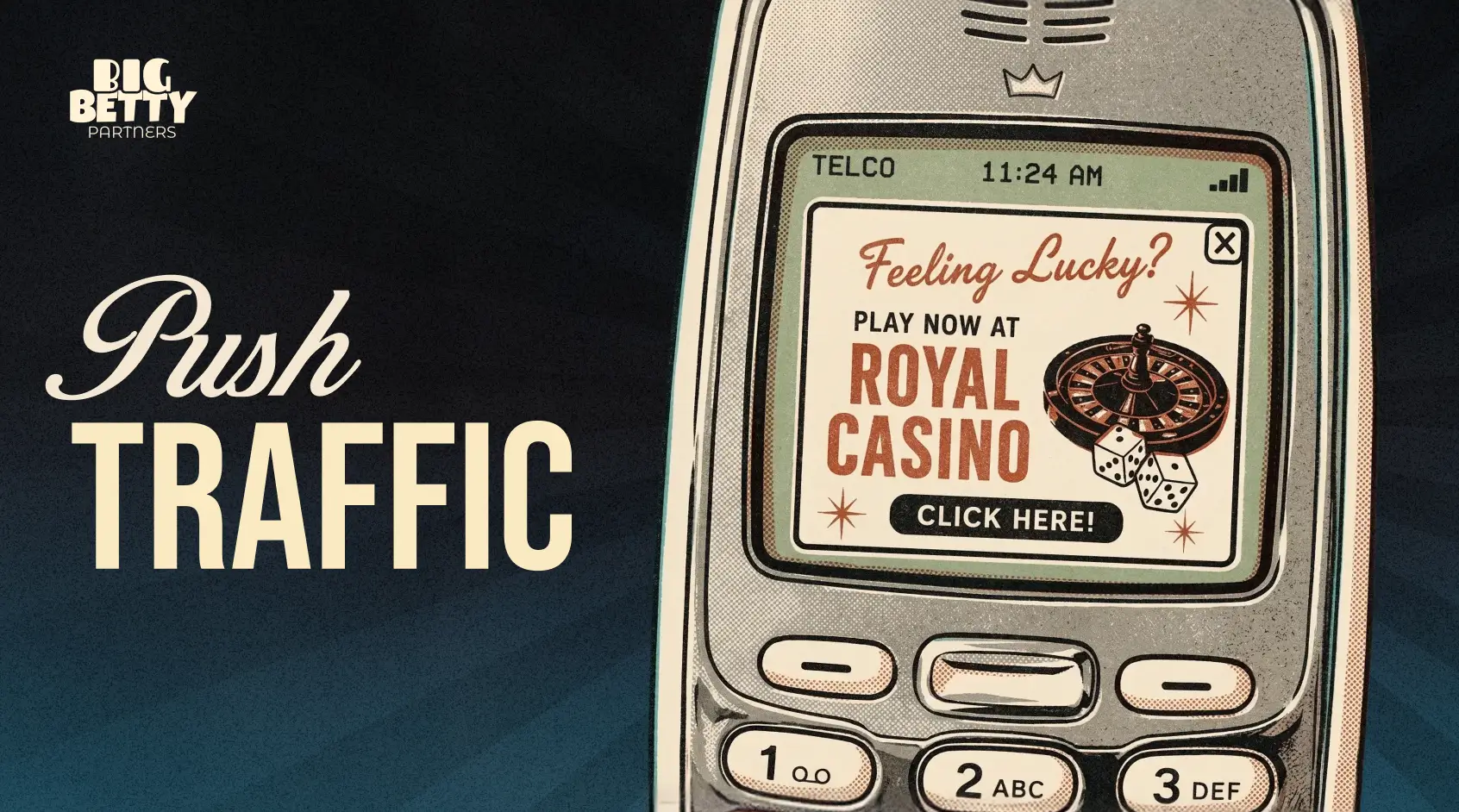
Push notification marketing still works for iGaming affiliates in 2026, but the market has become significantly more competitive and selective. Networks such as RichAds report push CPCs starting at $0.005 alongside billions of daily impressions, yet low-cost traffic alone is no longer enough to achieve profitability.
Campaign performance now depends heavily on subscriber list age, device distribution, creative approach, and format selection. Classic push traffic still excludes iOS audiences, while in-page push provides access across all browsers and operating systems. Affiliates who continue to scale push traffic successfully focus on precise audience targeting, format optimization, and data-driven creative testing rather than broad campaign launches.
💡 This guide covers one piece of the puzzle.
See the full picture: The complete iGaming traffic sources hub

Push Traffic vs Other iGaming Traffic Sources: The Actual Trade-offs
Push traffic occupies a very specific role inside affiliate marketing. It is not replacing paid social, native ads, or pop traffic entirely. Its strength comes from scalability, lower entry costs, and faster testing cycles for affiliates working in the iGaming sphere.
Compared to paid social campaigns on platforms like Meta, push traffic avoids one of the biggest operational headaches: account instability. Mainstream social platforms continue tightening moderation policies around iGaming campaigns, while push-focused ad networks openly support this vertical. RichAds specifically highlights its "loyal content policy" as one of the primary reasons affiliates continue using push traffic in 2026.
Native ads operate differently. User intent is generally stronger because the ad blends into editorial content, but traffic costs rise significantly. RichAds notes that native placements commonly start from $1.5+ CPM for domain traffic, while push campaigns can begin at $0.005 CPC. Push wins on affordability and testing volume, while native traffic often performs better for higher-intent funnels.
Pop and popunder traffic remain cheaper on paper, with RichAds reporting CPMs around $0.5 for some campaigns. Still, push notifications are less intrusive because audiences have previously opted in. That difference matters for long-term engagement when working with licensed brands in the iGaming sphere.
Another operational detail affiliates often underestimate: mobile dominance. RichAds reports that roughly 90% of push traffic inventory across major networks comes from mobile devices. Desktop campaigns still work, but they require tighter OS and device targeting.
| Traffic Source | Typical CPC/CPM | iOS Reach | Opt-In Required | Platform Risk | Best Traffic Environment |
|---|---|---|---|---|---|
| Push Traffic | From $0.005 CPC | IPP only | Classic push: yes | Low | Android-heavy traffic |
| Native Ads | From $1.5+ CPM | Yes | No | Medium | Higher-intent traffic |
| Pop/Popunder | Around $0.5 CPM | Yes | No | Medium | High-volume acquisition |
| Paid Social | Higher CPM variability | Yes | No | High | Warm audience retargeting |
"Subscriber freshness changes everything, sweetheart. New lists click fast but burn cash faster if your creative misses the mark. Profitable affiliates track subscriber age, device split, and traffic behavior before touching the scaling buttons. Push traffic rewards precision, not ego."
Sara
Content Strategy Lead iGaming
Classic Push vs In-Page Push for iGaming: Which Format Converts
Classic push and in-page push may look similar on the surface, but structurally, they operate like two entirely different traffic sources.
Classic push notifications require browser opt-in. Once the user subscribes, notifications can appear even while the person is no longer browsing the publisher's website. That off-site delivery remains the biggest advantage of classic push campaigns. The limitation? Classic push works primarily on Android and desktop environments. iOS audiences remain largely excluded.
In-page push, often shortened to IPP, solves that gap. Instead of relying on browser subscriptions, IPP displays directly on the publisher's page as a widget resembling a push notification. Because no opt-in is required, the format works across all browsers and operating systems, including iOS devices.
That difference becomes decisive in mature mobile traffic environments where iPhone usage is substantial. Affiliates relying only on classic push traffic effectively cut themselves off from a major share of mobile inventory. Traffic Nomads and Mobidea both identify iOS accessibility as one of the strongest arguments for using in-page push campaigns in modern iGaming acquisition strategies.
Adsterra reports that in-page push CTRs can outperform classic push by 10-30x on the same traffic segments. Still, there is a trade-off. IPP loses the off-site notification capability that makes classic push powerful for re-engagement.
Mobidea additionally highlights several high-volume mobile traffic environments as top-performing in-page push ecosystems, with iGaming listed among the strongest-performing verticals.
| Feature | Classic Push | In-Page Push |
|---|---|---|
| Browser Opt-In | Required | Not required |
| iOS Support | No | Yes |
| Ad Blocker Bypass | Limited | Yes |
| Off-Site Delivery | Yes | No |
| Best Use Case | Android-heavy traffic | iOS-heavy traffic |
The smartest affiliates do not choose one format exclusively. They separate campaigns strategically. Classic push performs well in Android-dominant traffic environments, while IPP campaigns achieve broader mobile reach in iOS-dominant environments.
Which Traffic Segments Actually Convert on Push Traffic for iGaming
Push traffic profitability depends heavily on matching the correct format with the right audience behavior.
RichAds identifies Android-heavy mobile traffic and desktop-focused traffic segments among the strongest-performing environments for iGaming campaigns. Mobile push inventory continues dominating traffic volume across most networks.
Emerging mobile-first traffic environments continue to attract affiliates due to lower acquisition costs. Evadav reports that some mobile traffic segments maintain push pricing below $0.01 CPC alongside strong mobile penetration and rapidly growing iGaming audiences.
Push traffic also remains attractive in developing acquisition ecosystems because lower CPCs allow affiliates to test more creatives, landing pages, and subscriber segments before scaling aggressively.
Language targeting matters more than many affiliates expect. A RichAds case study from January 2026 demonstrated that multilingual traffic campaigns required separate language targeting structures. Using only one language setting significantly reduced available reach and campaign efficiency.
| Traffic Environment | Recommended Format | Why It Works |
|---|---|---|
| Android-heavy traffic | Classic Push | Strong mobile inventory and lower CPC |
| Desktop-focused traffic | Classic Push | Better desktop browser coverage |
| iOS-heavy traffic | In-Page Push | Full iOS compatibility |
| Revenue Share optimization | Push + RevShare | Lower acquisition cost supports longer ROI windows |
Affiliates remain responsible for their own traffic source quality, targeting setup, and campaign compliance. Big Betty Partners accepts push traffic under PPC acquisition categories, but campaign performance still depends entirely on execution quality.
Setting Up an iGaming Push Campaign: The Configuration That Affects ROI
Push campaigns fail faster than most traffic sources when setup discipline is weak. Here is what experienced affiliates configure differently before spending serious budget.
-
Prioritize subscriber freshness
New subscribers between 0 and 7 days old generally produce higher CTRs but cost more. Older subscriber lists become cheaper over time, though engagement weakens significantly. RichAds recommends working directly with network managers to identify higher-performing sub-lists instead of running broad, untargeted inventory. -
Control frequency caps immediately
Starting with 1-2 impressions per user daily helps prevent audience fatigue. Increasing frequency too aggressively usually tanks CTR before the campaign even exits the testing phase. -
Launch with multiple creatives
RichAds documented a January 2026 campaign where only 1 out of 5 creatives generated all three conversions. The remaining creatives consumed roughly 80% of the testing budget without meaningful results. -
Set postback tracking before scaling
RichAds directly describes campaigns without postback tracking as "a waste of money." Reliable tracking becomes mandatory once campaigns start generating optimization data. Programs using Affilka integrations also support API and postback synchronization for affiliate reporting. -
Separate devices and connection types
Android and Linux combinations drove conversions in RichAds case studies, while iOS traffic required an in-page push rather than a classic push. Affiliates should also separate carrier traffic from Wi-Fi campaigns, as conversion behavior differs significantly in mobile-heavy environments. -
Start with controlled budgets
RichAds documented test campaigns operating at approximately $25/day budgets with CPCs around $0.045 during initial optimization periods. The first meaningful optimization pass occurred roughly 24 hours after launch. -
Automate rule-based optimization
Once enough data accumulates, automated rules should automatically cut losing OS combinations, weak subscriber lists, and poor-performing placements. Manual optimization alone becomes inefficient at scale.
"First 24 hours? I want signals, not miracles. Watch CTR stability, landing-page engagement, and whether one creative starts pulling conversions early. If nothing separates itself after 48 hours, pause it and save your scratch for the next test."
Sara
Content Strategy Lead iGaming
Creative Angles That Work for iGaming Push Ads
Push creatives operate inside tiny visual spaces, which means every word, emoji, and image element carries disproportionate weight.
RichAds identifies three core creative structures dominating successful iGaming push campaigns in 2026:
Familiarity Angle — creatives imitating recognizable interface elements or notifications to increase CTR.
Clickbait Angle — urgency-focused messaging using limited offers or time pressure.
Sensational/Emotional Angle — emotionally charged hooks paired with advertorial or text-heavy landers.
Mobile push notifications generally allow around 30 characters in the title before truncation begins. Effective campaigns place the core hook within the first 25 characters to preserve CTA visibility across devices.
Visual contrast also matters heavily. RichAds and Mobidea both report higher CTR with high-contrast visuals and emoji-enhanced text formats than with neutral designs.
Landing-page structure should align with creative angle selection. Interactive landers using gamified mechanics often convert faster from push traffic, while advertorial-style pages tend to perform better with emotional or sensational hooks.
Affiliates also continue to rely heavily on spy tools like AdPlexity and Spy Push to monitor live campaigns and identify winning structures before launch. The key is adaptation, not blind cloning. Subscriber pools fatigue quickly, so creatives typically require refreshing every few days once CTR starts slipping.
One RichAds case study from January 2026 demonstrated this perfectly. The winning creative used a familiarity-style visual resembling a mobile notification interface. The campaign operated around $0.045 CPC and began generating conversions during the first day.
The Networks Running iGaming Push Traffic in 2026
Not every push network treats iGaming traffic equally. Some openly support the vertical, while others quietly limit campaign flexibility or the quality of inventory.
| Network | Daily Impressions | Push CPC From | iGaming Allowed | In-Page Push | Minimum Deposit |
|---|---|---|---|---|---|
| RichAds | 5B+ | $0.005 | Yes | Yes | Varies |
| PropellerAds | 12B+ all formats | Low CPC model | Yes | Yes | Varies |
| Pushground | N/A | Competitive CPC | Yes | Yes | Self-serve |
| Evadav | Large mobile inventory | Competitive CPC | Yes | Yes | Varies |
RichAds remains one of the largest dedicated push-traffic platforms in affiliate marketing, operating across 20+ regions, with a strong presence in Europe, and offering Automated Rules and Performance Mode optimization systems.
PropellerAds reports more than 12 billion impressions across all formats, alongside approximately 15 million daily push impressions and 4 million in-page push impressions. The platform also confirms active support for iGaming campaigns.
Evadav continues appearing in industry guides as an alternative traffic source for affiliates restricted to mainstream acquisition platforms, particularly because it supports in-page push inventory.
Before depositing on any network, affiliates should confirm vertical approval, postback compatibility, minimum deposit thresholds, and available optimization tools. Allowlisting functionality also becomes important once campaigns begin identifying profitable traffic segments.
Big Betty Partners is an affiliate program operating in the iGaming sphere with a marketing portfolio of 8 brands. Available payout structures include CPA, Revenue Share, and Hybrid models, depending on the quality of the traffic source and the campaign structure. PPC-focused campaigns can target a CPA range of €300-€700, while Revenue Share models can scale up to 60% depending on the agreement structure. The affiliate program works with licensed brands and supports multiple performance acquisition models for experienced affiliates.
We separate performance metrics by acquisition channel and do not combine them into a single benchmark.
- SEO/PPC Reg-to-Dep: 20–60%
- FB/ASO Reg-to-Dep: 30–50%
- In-app Reg-to-Dep: 15–30%
- Click-to-Deposit: 20%
- PPC payouts: 300–700
- FB (In-app, ASO): 100–250
- SEO payouts: 100–600
- Influencer payouts: individual agreements
Only the sharp minds survive long enough to scale push traffic consistently, peachy keen pal. The clicks are cheap. Precision is not.
F.A.Q.
-
What is push traffic in affiliate marketing?
Push traffic refers to visitors driven by push notification ads — brief, opt-in messages delivered to users' devices via browsers or apps. In affiliate marketing, advertisers buy push traffic from ad networks such as RichAds or PropellerAds, while publishers build subscriber lists of users who agree to receive notifications. Advertisers pay per click (CPC) to deliver their offer creative to those subscribers.
-
Does push notification marketing still work for iGaming in 2026?
Yes, but with narrower margins than in 2020-2022. Push traffic remains one of the few ad formats that iGaming campaigns can run without risking mainstream social accounts. Networks like RichAds and PropellerAds explicitly allow iGaming vertical campaigns. The format works best in Android-heavy traffic environments and, via in-page push, across iOS traffic as well.
-
What is in-page push, and how is it different from classic push?
In-page push (IPP) is an ad format that looks like a push notification but displays as a widget directly on the publisher's website, without requiring browser opt-in. Unlike classic push, it reaches iOS users and works across all browsers and operating systems. In-page push ads also bypass ad blockers. The trade-off: classic push delivers notifications off-site, even when the user is not on the publisher's page.
-
How much does push traffic cost for iGaming campaigns?
Entry-level CPC starts at $0.005 on networks like RichAds. Real campaign CPCs vary by traffic segment and device targeting. A realistic testing budget for a push campaign usually starts at $25-50/day during the first 48 hours, while affiliates test multiple creatives and subscriber segments.
-
Which traffic environments work best for iGaming push ads?
Mobile push campaigns perform strongly in Android-heavy traffic environments, while desktop push still delivers scalable inventory in mature traffic segments. Affiliates should avoid running classic push in iOS-dominant environments and instead prioritize in-page push.
-
What conversion rate should I expect from iGaming push traffic?
Specific CTR benchmarks for iGaming push campaigns are rarely disclosed publicly by networks. General push advertising often achieves 1-3% CTR, compared with roughly 0.1% for standard display ads. Adsterra reports that in-page push campaigns can outperform classic push CTRs by 10-30x on the same traffic segments. Conversion performance still depends heavily on creative quality, landing-page structure, and subscriber freshness.
-
How do I avoid subscriber fatigue on push campaigns?
Set frequency caps to 1-2 impressions per user per day during launch. Rotate creatives every few days once CTR begins declining because subscriber pools fatigue quickly. Use subscriber-age segmentation whenever possible: newer lists click more frequently, while older lists require stronger creative angles to reactivate engagement. Split-testing at least 5 creatives simultaneously helps isolate winners faster and reduce wasted budget.